

· 4 min read
What is surrogate modelling?
How neural networks can be used to approximate expensive simulations, speed up your workflows, save you time and money
What is surrogate modelling?
In many research settings scientists use predictive models to either forecast the result of experiments, understand how changing key variables impacts their science or understand the implications of observed data. For example, researchers might want to understand how changing the dimensions of an F1 car impact its aerodynamics or changing the dimensions of an antenna impacts its response to incoming signals.
Predictive models are crucial to understanding the world around us however they are often extremely computationally expensive. In many cases the computational cost of these models can delay or even prevent the development of world leading research. Surrogate modelling offers the solution.
The idea behind surrogate modelling is to take a few simulations with varying parameters and train a machine learning model to accurately predict the corresponding simulation outputs. A well-trained surrogate can predict simulation results in a fraction of the run time of the simulation often to an incredibly high degree of accuracy unlocking your research.
How can it help your business
Not only are surrogate models faster than the simulations they are trained on, they are also capable of interpolating between the parameter values they were trained on whether these are the dimensions of an antenna or the quantities of different chemicals in a reaction. This means that you can rapidly explore how varying the parameters of your model impacts your science.
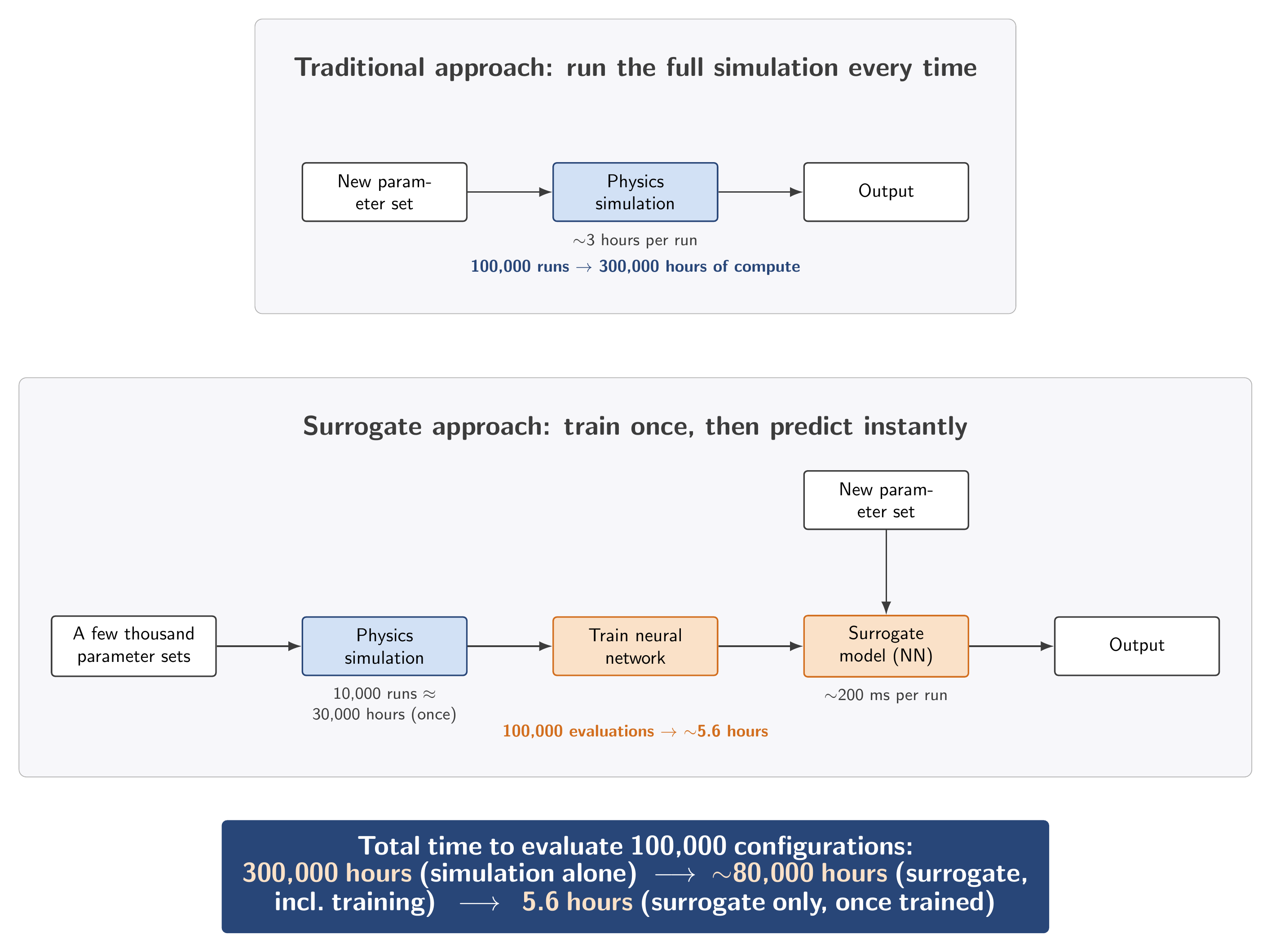
For example, let’s imagine that you need to evaluate your model for 100,000 different configurations and that the individual simulation takes three hours too run. That’s a total of 300,000 hours of compute. This of course can be parallelized over different devices but often at great financial cost to your company. Now imagine that a surrogate model can be trained on 10,000 simulations to an accuracy better than 0.1% with a few thousand hours of compute for training. Once trained the surrogate model can take you from the model parameters to the simulation output in say 200 milliseconds (neural networks are essentially just lots of vectorized linear algebra which modern computers excel at).
Now your goal to evaluate your model over 100,000 models looks much more manageable! With an initial cost to train the network of 35,000 hours (10,000 x 3 hours for the initial simulations + 5,000 hours for training), your 100,000 model realizations can be evaluated in roughly 5.6 hours before we even think about parallelizing the evaluation! Even if the training costs are 10 times more expensive the total amount of time needed to evaluate the set of simulations goes from 300,000 hours to roughly 80,000 saving your company both time and money. What’s more the surrogate models can be reused for other tasks in the future spreading that initial training cost across multiple projects.
Our expertise
Dr Harry Bevins has been building surrogate models for astrophysical simulations for the last seven years and has lead the field in developing state-of-the-art tools.
He first began developing surrogate models for simulations of the early universe. He demonstrated that simulations that normally take several hours to run on a supercomputer can be accurately approximated in a few milliseconds on a laptop. Using a series of novel architecture and data processing choices he developed a state-of-the-art neural network emulator or surrogate model that was twice as accurate and 102 times faster than the previous state-of-the-art in the field (see globalemu).
In subsequent work Dr Bevins, has shown how approximating complex simulations models with surrogate models can impact our understanding of the early universe. Surrogate models are often compared to observations to determine the characteristics of our Universe, but emulators are an approximation by definition. Understanding how the uncertainty introduced by that approximation in data space propagates through to the inferred characteristics of our Universe is non-trivial. With colleagues at the University of Cambridge, Dr Bevins developed a mathematic formula to relate the uncertainty in emulator predictions to inference products helping researchers better understand their results (see here).
More recently Dr Bevins has been working on building surrogate models for the directivity of Radio telescopes, mapping geometry through electromagnetic simulations to the response of the antenna to incoming power.
Dr Bevins is an expert in building surrogate models with years of experience and surrogate modelling has the power to save your company both money and time.